
Thriller, as a genre, has sub-genre's such as action or horror. The sub-genre determines what type of thriller it is, as there is a wide range of thriller's available.
For example, an action thriller can have certain features such as a race against time, violence, fighting and an obvious antagonist. The film would most probably include things such as guns, explosions, car races and other related things. E.g: The Bourne Identity/Supremacy/Ultimatum.
Another example: The Crime thriller sub-genre is a fusion of both crime films and thriller films, and it offers a suspenseful or mysterious account of a crime - successful or failed. This type of thriller usually focus on the criminal-characters, rather than the law enforcers. Crime thrillers are most likely to emphasize the action taking place over the emotional or psychological thoughts/aspects. E.g: The 51st State.
In a Drama thriller, the film would normally consist of "drama" aspects mixed with the thriller aspects. The film is usually more slow paced, and involves the characters developing emotionally, psychologically and sometimes physically. This usually coincides with the plot, and with its twists and turns. E.g: The Interpreter.
Psychological thriller, a normal conflict between main characters leading to an often violent resolution, is another sub-genre. The conflict between the characters is usually mental and emotional, rather than physical. The conflict could even be something that in real life, wouldn't be scientifically possible. This can include movies to the likes of and including "The Ring".
A sub genre of both thriller and spy fiction, is Spy Thriller. This usually involves a hero, who has some relationship with the government or is a government agent. The hero is needed to take violent action against a rival government or terrorists, though the latter is more of a recent making. E.g: Bourne Trilogy and Mission: Impossible.
Supernatural thriller, another sub genre, includes conflicts between some main characters. Usually one, both or all of them has super-powers, and may be considered a SuperHero or a Villain. E.g: Unbreakable.
A Medical thriller is a thriller with the hero/heroine as a doctor or a medical personnel. They work to solve a problem, the majority of which medical, or are sparked by a medical problem. Films such as "Awake" can be an example of a medical thriller, and "Diagnosis Murder" is an example of a TV medical thriller. Nonfiction medical thrillers can also be a subcategory, comprising things like "The Hot Zone".
The Legal thriller is a sub genre film type, in which the hero/heroine is a legal figure, like a lawyer. They usually have to deal with and confront enemies outside, as well as inside, the courtroom, and are in danger of losing the cases or what they are fighting for, or even their lives. E.g: The Innocent Man.
Sunday, 22 February 2009
Thriller Sub-Genre's

Tuesday, 17 February 2009
Thriller Poster - Millers Crossing
The picture below is a long shot, and shows a wide mise-en-scene with simplistic features of a tall wood and gravel road. The long shot includes the height of the trees but only a small stretch of the road, and it disallows us to see who they are or what is exactly happening. This creates mystery and tension, making someone want to buy and watch the film.
 a) This man seems to have high authority in the picture as he is suited and is not getting beaten up. However it seems as if he has a lesser status than the other suited man, as he is more like a chauffeur, closing the car door and tucking in his jacket. He seems disinterested in what the other man is doing, and holds himself in a buisness-like manner. He doesn't seem to acknowledge how they've taken a man into the woods, and this shows how the situation is not meant to be publicised, as they've driven far out and there are only the 2 of them dealing with the man in a buisness-like way. The hats they are wearing suggest authority and also hides their facial features.
b) The bottom of the picture is darkened until black, creating the effect that the image is an old one, that has been worn away, like the title. It also gives shadow and mystery because of the added darkness it brings to the image. It slowly and slightly gets lighter toward the figures, giving them more attention and focus in the frame of the mise-en-scene.
c) The majority of the picture is taken up by the tall thin tree's in the background, showing that the picture is set in the woods. The trees hold thriller signifiers, like how the light shines through some of the trunks, however most of the light is blocked out and creating shadows amongst them. This could create a sense of danger, and how they're out of the city life, in the middle of the wood. Because there are obviously a lot of tree's surrounding them, letting not much light in, this could create claustrophobia, as they're hidden away from the outside life.
d) The same writing as the title, showing who directed and wrote the film, at the bottom and out of the way in the mise-en-scene, but made kind of prominent because of the light writing on the darkened background.
e) The man at the edge of the picture seems to be kneeled over in pain which by the look of the middle man's posture, seems to be inflicted by the latter's shoving. This shows that the 2 suited men are powerful and are inflicting pain onto this third man. The 2 suited men are dressed rather like policemen, with the hats and the long coats, portraying the corrupt force or an immoral way of using the power they are given, to sort out crimes, and earn respect.
f) We can see that the road seems to stretch round into the distance, using vanishing points, which is a thriller signifier. The road also seems to curve round, creating a long and non-ending feeling to the road, as if they are really far out, and far away from any help that could be longed and called for from the un-suited man.
g) The title of the film, "Millers Crossing" is written on a sort of slant, higher on the side of the picture that the men are on, emphasising their presence slightly. It's a light brown/cream colour, like a faded letter of coffee stain. The letters are faded around the edges and in the middle, as if they had been bashed or ripped. This creates a feeling of dancer, and the sense that the place isn't safe. The actors names are above, written in the same style of writing but smaller, with the last names capitalized, bringing more attention to the famous surnames, but not drawing attention away from the main title and the scene below it.
And this second one is an advertisement poster, that could have possibly been on a billboard or bus stop, etc:
This poster is also taken at a long-shot, with the tall tree's dominating the upper half of the picture, some in the background, and some in the foreground. The distance shows us alot of leafy ground and the forest looks misty and sort of eer-y. The picture is taken from a camera that seems to be quite low to the ground, as if another person was crouched where the camera is, watching the scene infront of them unfold.
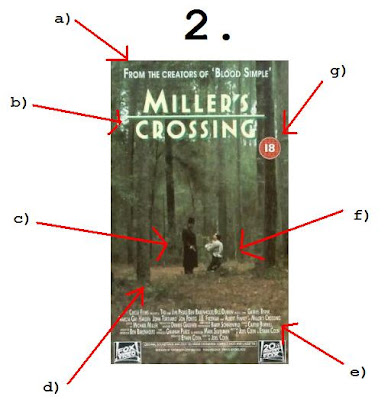 a) The "From the Creators of" title shows the audience another Thriller by the same people who wrote and directed the film. The writing is lightly coloured against a dark-ish background, against the top of the tree's, which seem thicker toward the top of the picture, because of the amount of tree's. It is clearly daylight behind, however the tree's block out most of the natural light, making it dimmer.
b) The title "Miller's Crossing" is in a plain font, that looks quite old. The line through the middle of the words suggests hidden secrets because of how its splitting the title in two. It is against the top of the tree’s, which are letting odd bits of light flow through them, showing that its daytime and light.
c) The figure in the black, with the tall black hat seems to be standing very upright, making himself taller to the man kneeling in front of him. He looks as though he knows what he’s doing, and he’s in charge. In his right hand he seems to be holding what looks like a gun, giving him a sense of power and maybe even danger in this photo. The clothes he is wearing makes him look quite mysterious, as they’re just a plain colour black, not giving anything about his identity away, though suggesting he is a figure of authority.
d) The scene that the two figures are in looks like a forest, with tall tree’s and leaved grounds. They are standing/kneeling in a clearing in the forest, between two tall trees with a backdrop of a thick forest behind them. The lighting seems natural and filled with shadows on the ground, as the tree’s are blocking out most of the sky light.
e) The bottom of the poster holds information about the film. The actors names and the companies that have funded it and produced it. One obvious company involved is Fox, as it has 2 adverts in the bottom corners of the picture.
f) The other man in the picture, who is kneeling at the feet of the black dressed man, seems to be pleading with his hands and voice to the other man. He obviously has a lesser status than the other man, as he is on his knees in a begging position. His clothes seem to be smart, giving him a sense of wealth maybe, however they aren’t tucked in or looking as smart as they probably usually would. This gives the viewer the impression that he is not in control of the situation, and that he is in a bad position.
g) The certificate is 18, in its usual red circle, upper right corner of the poster. This could attract the suitable audience that the film would want, as over 18's would relate to the symbol straight away, and think that the film might be suitable for them, as if it was a 15 there is a chance it might be too "teen-age boy" for them. It could connote that the film is a serious thriller, an "adult film".
Monday, 19 January 2009
No Country For Old Men - Coen Brothers
The narrative is quite simple and straight forward, a chase between a psychopath and a sheriff (who is holding $2,000,000 and a stash of heroin). The psychopath will stop at nothing to get to the sheriff and claim his money and drug prize, and doesn't hesitate to kill anyone who even remotely gets in his way.
The film is filled with manby different shot types, and thriller signifiers. E.g: the mise-en-scene for the larger part of the film is filled with open spaces, mainly desert land with intense scenery. The rule of thirds is put into action in one particular spectacular shot when the sheriff looks through binoculars at a dead man's shoe next to a tree, which casts long dark shadows (which is an intense thriler signifier).
The film has many grusome scenes, as we witness many wounded/dead men, and a fair few murders. The pace of the film overall is slow, not rushed, making it more intense to watch, because the action doesnt rush through, it takes you through each murder and scene slowly. I think this gives it more of a sinister feel, as we see everything in detail.
In many scenes, the fact that there is no non-digetic or digetic sounds, so its deathly quiet, creates more sinister feelings, and mystery and keeps the audience on the edges of their seats, as this mainly happens before main or shocking parts of the film.
The film won 4 Oscars, and 90 other wins, with only 36 unsuccessful nominations, so overall was a very sucessful film.
Sunday, 18 January 2009
Thriller Opening - Vertigo.
Mise-en-scene:
The film opens with worried/scared eyes, glancing in different directions.
The first action we see is a police chasing a man across rooftops, with help, Good Vs Bad.
People we haven't been introduced to, we don't know who is the main character, creates Mystery.
The police-man dies within the first 5 minutes, confusion, (Good has lost?)
Lots of red colours in the mise-en-scene, connoting danger, passion and lust/love. (lipstick, walls, clothes).
Camera Angles/Shots:
Extreme close-up on all the main features of a person's face.
Then another extreme close-up on the top bar of a ladder, with hands gripping it.
Birds eye veiw, camera zoom emphasizes the height.
Close up on the police-man's face, to show his fear, gets closer.
Includes various types of shots: close, long and mid shots.
Sound:
Non-digetic tense music to start, repetitive, loud vs. quiet.
No digetic sound to start with.
Non-digetic orchester, spooky/threatening music but "nice".
Quick paced music, speeds up at the end of the intro, getting faster and faster.
Digetic sounds of gun shots at the start, and scrabling.
Non-digetic dark music at important times.
Editing:
Fading effects from shot to shot, and from scene to scene.
Quick paced editing to create more tension and quick movement in the chase.
Special Effects:
Spiral pattern from the eye to the screen with names and colour.
Face turns red with title "Vertigo" on the screen.
Spinning patterns in background, creating mystery. The spiral effect connotes mystery and danger, no end? getting lost?
Finger Prints.
Other Notes/Thriller Signifiers:
Flawed hero, main character has agriphobia, fear of heights.
Detective man, thriller signifier.
Long winding narrow roads.
Dreary settings.
Contrasting between the light and the shadows.
Wierd twists and links, zooming to show them.
Thriller Signifiers.
Mystery and intrigue - keep the audience guessing, draws them in.
A twisting and turning narrative - shock and surprise, makes the film more interesting.
Spiralling narrative - keeps the audience in awe, again, adds interest.
Narrated by a male protagonist? (First Person)
Chases & Pursuits - action and excitement.
Tone and Atmosphere:
Sinister or threatening atmosphere - keeps interest and excitement.
Sexual/Sleaze.
Claustrophobia - introduces fear and worry.
Mise en Scene:
Bleak settings.
Urban.
Rain lashed streets.
Shadows - dark spaces where we can't seem creating mystery.
Set in the night time - more darkness and more shadows, mystery and danger.
Slatted Blinds - introducing shadows again.
Slanting light, creating shadows - connoting mystery.
Staircases - long and winding, no end/fear/anxious.
Enclosed spaces - claustrophobia again, fear and worry.
Chiaroscuro lighting - originated with artwork, includes dark shadows contrasted with bright light.
Characters:
Femme Fatales - red lips, "sexy" clothing - but not revealing, usually "dangerous" and vulnerable.
Hard-boiled detectives - don't like to show emotions, spying and deception included.
Flawed heroes - E.g: Chinatown - acrophobia, other movies the hero could smoke/drink excessively.
Male protagonist - usually a detective, or socially alienated individual.
Women as sex objects.
Police - authority, police are meant to be good, good-cop/bad-cop could come in. Flawed or corrupted police-men?
Themes:
Corruption - fake identities/lies/good-cop gone bad.
Mystery - unknowing circumstances, guessing, intrigue!
Deceit - misleading, falsehood, half-truths and lies.
Sexuality - women using as a weapon.
Women's sexuality as dangerous and destructive - men fighting over a woman? woman using her sexuality to get her way? woman's sexuality destroying evidence or a case against a murder?
Moral ambiguity - who is right and wrong?
Cinematography:
Tilted camera angles - not straightforward, wonky, twisted narrative? suggestive.
Use of vanishing points - roads that vanish in the distance, whats over the horizon? is there more than what appears in the mise-en-scene? creates mystery.
High angle and low angle shots.
Friday, 12 December 2008
Thriller Opening - Layer Cake
Director: Matthew Vaughn, 2004.
Opening shot/Mise-en-scene/shot types: medium shot of the explosion in the van, genrly zooms out, instantly makes impact and grabs the audiences’ attention. Close up of drugs, and shown different time period flashbacks. Siren and camera zooms out and begins panning, slow paced film, high angle shot which makes the characters look like they are being watched, long shot shoging the drive in, extreme long shot following the car going along rural road to large mansion. Midshot shows them walking, following the characters and rorates around table whiles rockish music played.
Opening credits: First titles of producers etc, centred and plain with no music. Black and white, white writing of title layer cake on the door of his terrace house.
Narrative perspective: internal monologue – thriller signifier – match everything up and well fitting for a good carry off.
Mise-en-scene: switching places in periods of time, reflecting different periods, prison, flower drug power, modern day, innocent and clean more professional and pharmacy suggesting pharmaceutical lifestyle. Shot in London following Daniel Craig down the road, contempory music, chilled, male protagonist, flaw of drugs and drug dealing.
Editing: drugs in what looks like a pharmacy storage room, into a pharmaxy. Shots fade into others. Diegetic music faded out and went white, went to show a car shot. Goes into another shot lots of people contrast of people lower class and professional dealers.
Thriller Opening - Sin City
Opening Shots/Mise-en-scene/Shot stpyes: establishing shot, urban city setting, seductive woman with red low backed dress. Two person shot, slow jazz music (film noir) non diegetic sirens and city noises. Birds eye view. Car view camera shot exactly like in Chinatown and vertigo. Chiaroscuro lighting. Woman looked in the camera zooms out whilst panning and goes in a spiral (thriller signifier) twists occurring.
Opening credits: explosion, city, font of credits look almost cartoony or as if written for a comic book – white outlines. Red writing, balck and white background. Images behind the text like guns, people (possible characters) stills that move across the screen, all drawn as comic books are. Film is based on drank miller’s graphic novel so use od the graphic images is almost a reminder of his book, influenced the film.
Mise-en-scene: raining/slashed streets, classic thriller signifier. Wet lashed streets and balcony with smoke. Bleak atmosphere, woman is vulnerable but sexy and possible dangerous. Eyes flash green sugguesting emotion (jealousy?) man seems protective. Monochromatic black and white flash of the scene when they kiss, more reminder of the graphic novel.
Editing: black and white, red dress and gren eyes only colour, slow paced shot editing, showing contrasts, and monochromatic flash.
Narrative perspective: voice over of the man, internal monologue.
What makes a thriller introduction successful:
- Mystery/Intrigue
- Possible cliffhanger
- Clever and effective editing
- Good/steady camera shots.
- Appropriate lighting/dress/props
- The abililty to "hook" or "engage" the audience, so they're interested in the rest of the film
- Good use of the mise-en-scene - Effective
- Originality/Individuality
- Effective framing, compostion (rule of thirds)
Thursday, 13 November 2008
Narrative Of China Town
In the beginning we are introduced to a character called “J.J” Gittes, who is a private detective. A woman who we think is Mrs Mulwray is hiring Gittes to spy on her husband, as she thinks he is having an affair. This introduces the feel of deception and mistrust, and the woman is a typical femme fatale, with red lips, silky expensive clothing and a cigarette.
However, this soon easy-to-understand plot we are introduced to very quickly goes pear-shaped, with a twist and deception of identity, as a new typically femme fatale woman introduces herself as Mrs Mulwray, proving the other Mrs Mulwray to be a fake. Soon after, having discovered corrupting evidence against Mr Mulwray whilst tracking him to discover his affair, Gittes investigates into the water reservoir plot, and discovers Mulwray to be dead, and Evelyn’s (Mrs Mulwray) father to be his business partner. Gittes uncovers a big plot formed by the water department, suggesting they’re forcing farmers out of their land so they can buy it cheap, and selling it back at a much higher price as they’re fertilising the land with water they’re diverting from the reservoirs. However they are putting pensioners in a retirement home unknowingly legally in charge of the land. During this discovery, Gittes and Evelyn strike up a romantic relationship, which is cut short when Evelyn receives a dramatic phone call making her leave him for a while.
Gittes follows Evelyn to a house to find her keeping Mulwray’s mistress against her will. Gittes confronts Evelyn, who tells him that the girl is her sister, and distressed because she has only just learned of Mulwray’s death. Later on another twist develops as the police point out that Mulwray’s lungs were filled with saltwater, even though he was found in a freshwater reservoir. Gittes goes to the Mulwray mansion, and finds glasses in their back-yard bond, which is filled with saltwater.
The climax of this film is when Gittes confronts Evelyn, and she reveals that Catherine (her husband’s mistress) is her daughter and her sister, revealing the sexual relations she had with her father, however her father had taken advantage of her.
More on the mise-en-scene of Chinatown:
Slatted blinds.
Character drinking & smoking.
Shadows in the corners.
Spying/surveillance - binoculars.
Watching man in wing mirror
Fan in the background.
Chiaroscuro lighting.
Deception - hidden identity (of the daughter).
Red lips, blonde/brown hair, tight suit - Femme Fetal.
Gun shot.
Violence- knife.
Camera angels/Shot types:
Extreme close-up on photo- black and white, gently zooms out.
Over the shoulder shot showing a subject that has more importance.
Long shot - shows hostility and harsh surroundings.
Mirroring reflection of man walking away, shot through binoculars.
Close up of watches.
High angled shot.
Another reflection in man's camera- you can see man/women.
Over shoulder shots, close ups, mid shots, extreme close ups, long shot, birds eye view (used to show emotions on faces of character, e.g. Jake lying in bed with Mrs Mulwray).
All making the audiences attention focus more on the film, keeping them engaged in what is happening (narrative-wise).
Sound:
Jazz music in introduction, relaxing and soothing - non- diegetic
Calm, quiet music- makes you question what he is doing
Tension music - minor key, makes you feel not-quite-right ~ repeated when looking at lake for men. It builds suspension Romantic music used.
Editing & Special Effects/ SFX:
As Jake falls unconscious, the shot fades out.
One of the security guards cutting Jake's nose open with a knife.